
Two University faculty, both certified audiologists, are the first to study how tinnitus impacts student veterans as they navigate college classrooms.
Hearing loss and tinnitus are the two most common service-related disabilities among U.S. veterans, affecting more than three million people nationwide.
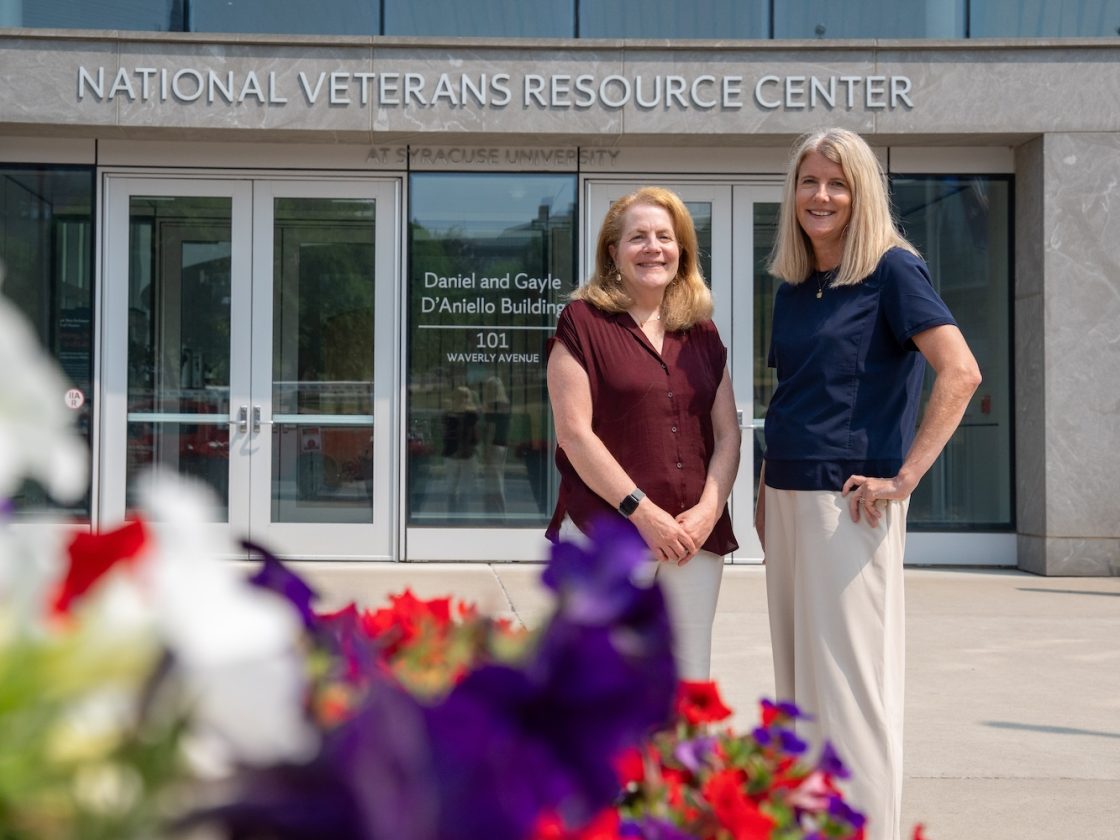
Knowing military service members are routinely exposed to noise that can cause lasting auditory damage, which can make school harder for active duty and student veterans, Karen Doherty, senior associate dean for faculty affairs and professor in the Department of Communication Sciences and Disorders in the College of Arts and Sciences, and Tammy Kordas, associate teaching professor also in CSD, set out to learn how tinnitus may be impacting veteran students on campus.
When the two certified audiologists initially went looking for existing research on the prevalence of tinnitus—a ringing or other noise in the ears that isn’t caused by external sound—among veterans on college campuses, they found almost nothing.
Doherty says the sparse literature on student veterans and tinnitus wasn’t entirely surprising. Most tinnitus research focuses on older veterans, the demographic that arrives at VA medical centers in their 60s and 70s, ready for hearing aids for diagnosed hearing loss.
Student veterans, meanwhile, appeared to occupy a different and largely unexamined space.
“You might have ‘normal’ hearing yet have a lot of difficulty hearing in background noise as well as challenges in trying to deal with the secondary effects of tinnitus,” Doherty says.
To get a sense of how much tinnitus impacts student veterans, they sent out the survey with the help of retired U.S. Army Colonel Ron Novack, executive director of the Office of Veteran and Military Affairs.
Kordas, Doherty and Novack all agree that identifying the scope of the problem is only the first step toward developing meaningful support and solutions.
“It gives us more of an opportunity to move from an anecdotal awareness on campus, toward a more data-informed understanding of how this issue really affects student veterans at the University,” Novack says.